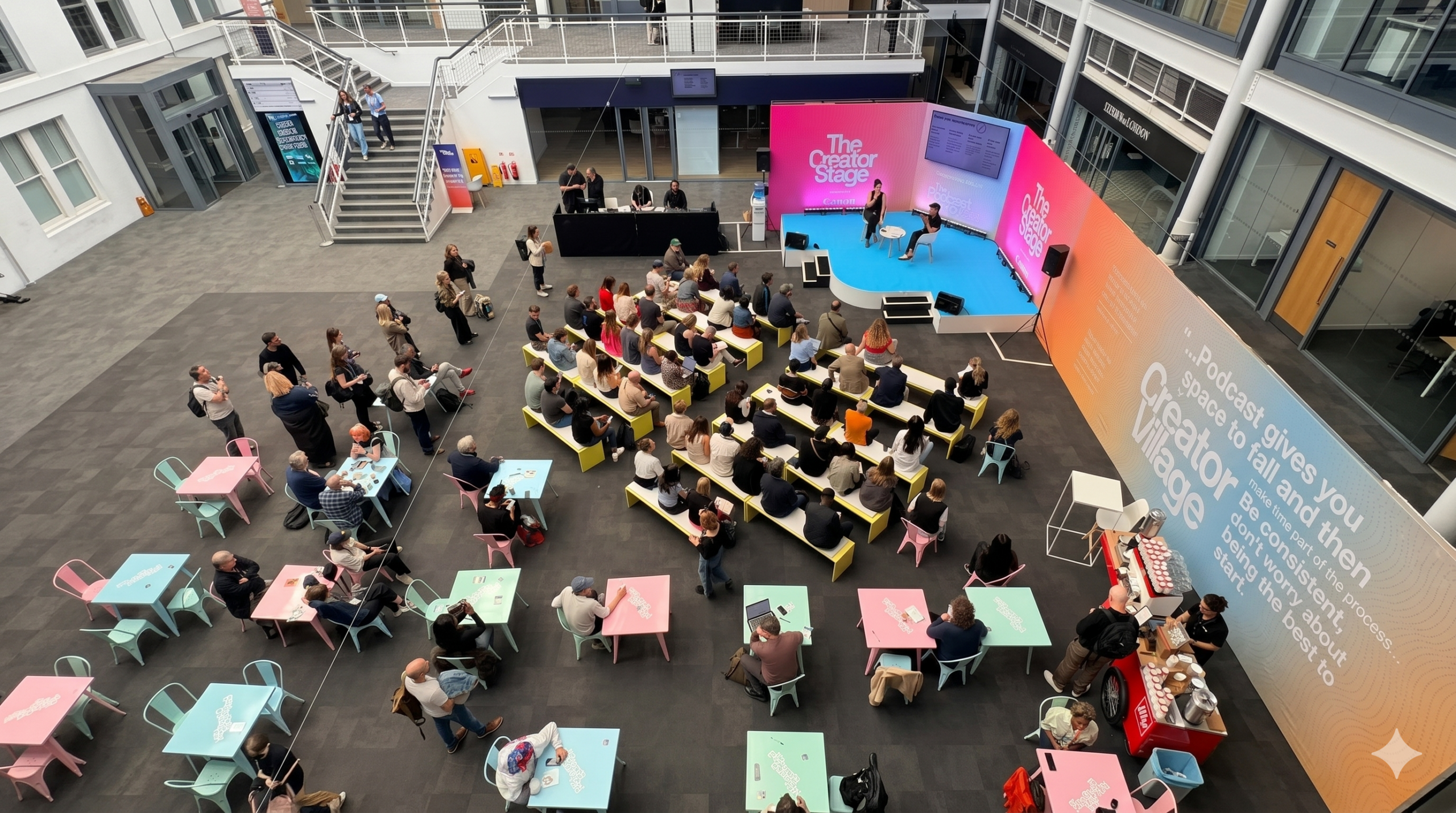
Alex Lamb reflects on the biggest themes from The Podcast Show London 2026, from video-first podcasting and niche audiences to the growing importance of community-led content.
Somewhere between Bishop’s Stortford and Liverpool Street Station, while listening to a podcast on the train heading to The Podcast Show London, I realised I was probably on my way to the only event where that counts as ‘pre-event research’.
Once there, one thing became very clear: podcasting has evolved far beyond audio in the way I had just been listening to it for the past hour and a half.
Across sessions featuring broadcasters, creators, studios and platforms, the same themes kept surfacing. Video is now central to podcast growth. Niche audiences are becoming incredibly valuable, and the strongest shows are no longer just podcasts: they’re built around communities.
Three sessions in particular stood out:
- How TV titans and star creators are growing their business in the new video-first age – Learn more
- Podcast shows at the FIFA World Cup 26 – Learn more
- To niche or not to niche? – Learn more
While each approached the industry from a different angle, together they painted a clear picture of where podcasting is heading next.
- Video-first is now the standard
One of the biggest takeaways from the day was how naturally speakers referred to podcasts as ‘video products’. A few years ago, filming podcasts still felt optional. Now, it feels essential.
During a session featuring Piers Morgan (who was sporting an Arsenal shirt fresh off the back of the team winning the league) there was much discussion about the convergence of traditional media and creator-led content. Broadcasters are embracing creator behaviours, with Morgan saying that if you “want to see where the world is going, look at how the young people are consuming their content”. As a result, digital creators are building increasingly sophisticated media businesses around video-led formats.
That same point came up again during the football-focused panel with Jamie Carragher (Host of Stick to Football) and teams behind The Overlap and The Fellas Podcast.
One particularly interesting point was around how audiences now consume podcasts through YouTube on their TVs rather than through traditional podcast apps. Podcasts are increasingly competing with mainstream entertainment and broadcast viewing habits, not just on the radio in the car or the kitchen.That shift changes everything from production style to distribution strategy.
Short-form clips also came up repeatedly throughout the day. Rather than replacing long-form content, they’re now acting as discovery tools, helping audiences find personalities, moments and conversations before committing to full episodes.
- The power of niche audiences
The session To Niche or Not To Niche? offered some of the strongest insight into audience growth and community-building.
Callum Airey, co-founder of The Fellas Studios, made a compelling case for creators “niching down” early rather than trying to appeal to everyone immediately. His simple logic is that communities form around shared interests and identity. Broad content may attract views, but niche content builds loyalty.
Particularly interesting was the idea that “niche” isn’t just about topic, it’s about audience behaviours.
Using football as an example, speakers discussed how different shows serve different fan needs. Some audiences want tactical analysis, others want entertainment, reaction content or fan culture. The successful creators understand exactly what audience they’re serving and build content around that. That feels increasingly relevant for brands too.
- Community matters more than reach
The word ‘community’ came up constantly throughout the day. Not listeners. Not viewers. Communities.
That shift says a lot about where podcasting is heading. The most successful shows today are no longer passive experiences; audiences want interaction, participation and conversation.
Sports podcasting provided some of the clearest examples of this. Creators spoke about optimising content around YouTube comments, live chats and social clips, because audiences increasingly want to feel involved in the discussion. hat’s something traditional broadcasting has often struggled to offer.
At the same time, the gap between traditional media and creator media is narrowing rapidly. Broadcasters still bring huge advantages in terms of infrastructure and production scale, while creators often understand platform culture and audience behaviour more instinctively. The result is a blending of the two worlds.
Broadcasters are becoming more personality-led and creator-focused, while creators are building increasingly professional media brands around their shows.
What our clients and brands should take from this
For us at CPL One, the day reinforced something we’re already seeing across video and digital content more broadly: audiences respond far more strongly to authenticity, community and platform-native storytelling than they do to polished corporate messaging alone.
The creators growing fastest are the ones who truly understand their audience, create content designed for how people actually consume media today and build loyal communities around shared interests.
Podcasting is quickly becoming something much bigger than audio alone, evolving into community-led, video-first media built around personality, trust and participation. And increasingly, those same principles apply across all modern content marketing too.
Alex Lamb is Account director – video and digital content at CPL One
To find out more about how we can help with podcasts or video, email [email protected]